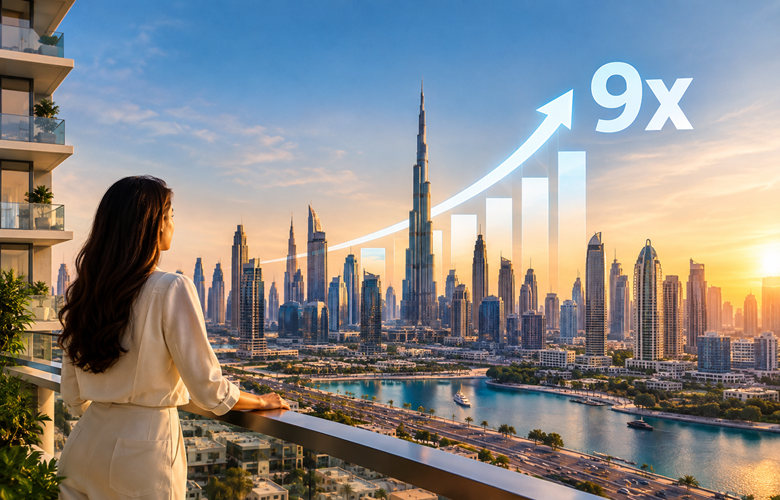
Apartments in Dubai market recorded 165,684 transactions worth AED 319.9 billion in 2025, a 30.5% rise in volume over 2024, based on DLD-registered data. Apartments accounted for 83% of all residential transactions that year, making them the most bought property type in the city by a wide margin. From 2020 to 2025, apartment transaction volume grew nearly 9 times while the median price per sq ft rose 60%. Dubai’s population crossed 4 million in August 2025, adding over 208,000 residents that year alone. The Dubai 2040 Urban Master Plan targets 5.8 million by 2040.
Population Growth and the Golden Visa Are Reshaping Who Buys
Dubai passed 4 million residents in August 2025. Over 208,000 people moved to the city in that year alone, roughly 470 new residents arriving every single day. More than 92% of Dubai’s population are expatriates, and the vast majority of them, whether professionals, entrepreneurs, or young families, look for apartments when they first settle and often stay in the apartment market for the long term.
Population growth alone does not explain the full picture. The nature of who is coming has changed. The UAE’s long-term Golden Visa programme, introduced in 2019 and expanded since, shifted a large renter base into active buyers. Expatriates who once rented cautiously and planned to leave in three years are now purchasing with a 10-year horizon. A property investment of AED 2 million or above qualifies the buyer and their immediate family for a 10-year renewable UAE residency visa. That threshold sits within the apartment price range in communities such as Business Bay, Dubai Marina, Dubai Creek Harbour, and JVC, which is why demand in those areas accelerated after the visa expansion.
Long-term rental contracts in Dubai reached 530,000 agreements in 2025, a 5% increase year-on-year. Apartment asking rents rose approximately 10% year-on-year as of mid-2025, though growth has been moderating since the 2022 to 2023 peak as new supply enters the market. Dubai also introduced the Smart Rental Index in 2024 to bring transparency to rent increase rules, replacing the older RERA rental calculator. The tenant pool continues to grow faster than the city delivers new homes, which keeps occupancy solid for apartment owners in established communities.
Five Years of Dubai Apartment Sales in Numbers
The figures below come from DLD-registered sales records and show a near 9-fold increase in apartment transactions from 2020 to 2025:
- 2021: 33,146 apartment transactions
- 2022: 60,057 apartment transactions
- 2023: 91,823 apartment transactions
- 2024: 126,969 apartment transactions
- 2025: 165,684 apartment transactions worth AED 319.9 billion
Off-plan sales drove most of that growth. In 2025, off-plan apartment deals rose 37.7% year-on-year to 121,281 transactions, accounting for 72% of all apartment sales. The fastest-growing price band was AED 1 to 2 million, which produced 67,097 transactions in 2025. The only segment to contract was the sub-AED 500K entry-level tier, which tells you buyers are moving up the value scale, not down.
Apartment prices per sq ft in Dubai rose about 60% from 2020 to 2025. Annual price growth has moderated from 27.3% in 2022 to around 5% in 2025. That shift is worth understanding correctly: it does not mean the market is weakening. It means demand has moved from speculative activity to end-user and long-term investor buying. A market where growth is driven by people who need a home is more durable than one driven by short-term flipping. Buying before a population heading toward 5 million by 2032 creates the next demand wave is a more stable position than buying at the top of a speculative spike.
Why Supply Cannot Keep Up With Dubai Apartment Demand
This is the part most buyers do not fully understand. Dubai launched 152,402 residential units in 2025, but only 31,437 were actually completed. That is a completion rate of about 21%. The rest remain under construction or are delayed. At the same time, the city added 208,000 new residents in the same year.
Using a conservative average household size of 4 people, Dubai needs more than 40,000 new homes per year just to house incoming residents. Against a real delivery rate of roughly 31,000 to 46,000 completed units in 2025, the gap is genuine. The shortfall is sharpest in well-located, ready-to-move apartments within established communities. New supply coming to market is concentrated in peripheral areas such as Dubai South and Dubailand, where land is available, rather than in the inner communities where most renters and buyers want to live. That concentration of demand in established locations is what keeps rents and resale prices firm in those areas, even when total new-launch numbers across the city look high.
The Real Financial Case for Buying a Dubai Apartment
No property tax, no capital gains tax. The UAE charges no annual property tax and no tax on the profit when you sell. The only government charge on a purchase is the DLD registration fee of 4% of the sale price. Compare that to the UK, where stamp duty runs up to 12% plus annual council tax, or India, where registration and stamp duty together add 5 to 8% to the purchase cost. The difference in total cost of ownership over a 10-year hold is significant.
Rental income is tax-free in the UAE. The UAE levies no federal income tax. Rental income from a Dubai property is not taxed in the UAE, whether the owner lives in Dubai or is based abroad. Long-term residential tenancy contracts in Dubai are also exempt from VAT. For NRI investors, rental income from a Dubai property is not taxable in India for as long as you hold NRI status, since it is foreign-sourced income outside India’s tax net. If and when you return to India and resume resident status, your global income including Dubai rental income becomes taxable in India. Consult a chartered accountant familiar with both jurisdictions before remitting funds.
Rental yields well above comparable global cities. The average gross rental yield for Dubai apartments stood at 6.8% in December 2025. Studios deliver the highest returns on a percentage basis, at 7.8 to 8.8% gross. Average gross residential yields in London run at 3 to 4%, and Singapore sits at around 2.5 to 3.5%. Dubai’s higher yields, combined with zero rental income tax, produce a net return that is difficult to match in most comparable cities.
Freehold ownership for any nationality. Most major residential communities in Dubai are designated freehold zones. Buyers of any passport hold full ownership title registered with the DLD, with no restriction on resale, rental, or inheritance. This level of foreign ownership access is not available in most of Dubai’s regional neighbours.
Off-plan payment plans that spread the cost. Most off-plan launches in Dubai ask for a 10 to 20% booking amount, with the remaining balance spread across construction milestones and sometimes post-handover. A buyer can secure a unit worth AED 1.5 million with AED 150,000 to AED 300,000 at signing and build equity during the build period without carrying a full mortgage from day one.
Escrow protection on every off-plan payment. Under Dubai Law No. 8 of 2007, all off-plan payments go into a RERA-monitored escrow account held by an approved bank. Developers receive funds only as verified construction progress is confirmed. This legal structure removes the core risk of off-plan buying that exists in unregulated markets.
Living in a Dubai Apartment: What You Actually Get
For someone relocating to Dubai or buying their first property in the city, the day-to-day case for an apartment is practical rather than abstract.
- Building exterior, common areas, pool, and gym are managed by the Owners Association through the annual service charge. Owners handle only the interior of their unit.
- Amenities that would add significant cost to a private villa, including a pool, gym, children’s play area, and lobby security, come standard in most new apartment buildings.
- Communities such as Business Bay, Dubai Marina, Downtown Dubai, and Dubai Creek Harbour give residents walking access to restaurants, retail, and Metro stations that most villa communities do not offer.
- The AED 1 to 2 million price band produced the most apartment transactions in Dubai in 2025. It is the entry point into a prime Dubai community that villa prices in those same areas cannot match.
Pros and Cons of Owning an Apartment in Dubai
What works in your favour
- Gross rental yields of 6.5 to 8.8% for apartments, compared to 4 to 5.5% for villas, based on 2024 to 2025 market data.
- Lower entry price than villas, with the AED 1 to 2 million bracket generating the highest volume of transactions in 2025.
- Off-plan payment plans spread the cost across 2 to 4 years with a low upfront amount.
- JVC and Business Bay recorded the highest apartment resale transaction volumes in Dubai in 2025, which supports exit liquidity when you want to sell.
- Building maintenance is managed through the service charge, with no separate garden, pool, or exterior upkeep cost to budget for.
What to factor in
- An annual service charge of AED 10 to 25 per sq ft applies depending on the building. On a typical 700 sq ft one-bedroom apartment that works out to roughly AED 7,000 to AED 17,500 per year. Budget for this as a fixed annual cost of ownership.
- Private outdoor space is limited compared to a villa or townhouse.
- Communities without Metro or tram access require a car or cab for most daily trips.
- High launch pipelines in Dubailand, Dubai South, and some JVC sub-clusters could moderate rents in those pockets over the next two to three years. Research the completion pipeline in a specific community before buying purely for yield.
- Short-term holiday home rentals generate 20 to 40% more gross income than long-term leases in the same building, particularly in Marina, Downtown Dubai, and JBR. However, operating costs for professionally managed holiday homes run at 20 to 25% of gross revenue, versus 5 to 8% for long-term leases. On a net yield basis, a well-run long-term lease frequently matches or beats a holiday home return. A DTCM holiday home permit from an approved operator is mandatory to run a short-term rental legally.
Why Dubai Apartment Investment Outperforms Villas on Yield
Apartments make up 83% of all residential transactions in Dubai. That share has held steady across multiple years because the underlying demand has not changed. Most of the city’s incoming population rents an apartment first. Most tenants rent apartments. And apartment entry prices are accessible without a full mortgage in a way that villa ticket sizes, which typically start above AED 3 million in established communities, rarely allow.
For yield-focused buyers, the case for a Dubai apartment investment is clear in the numbers. At year-end 2024, the average gross yield for apartments across Dubai was 7.4% versus 5.1% for villas and townhouses, based on Cavendish Maxwell data. Studios produce the highest percentage return at 7.8 to 8.8% gross. Communities delivering above 8% gross in 2025 included Dubai South (8.5 to 9.5%), International City (8 to 9%), Arjan (7.8 to 9%), and Dubai Silicon Oasis (7.5 to 8.5%). JVC and Business Bay combine gross yields of 7.5 to 8.5% with the highest transaction volumes in the city, making them the practical choice for investors who want both income return and a clear exit route.
For NRI and Indian investors, the Golden Visa angle makes the calculation even stronger. Apartments priced at AED 2 million and above carry eligibility for the UAE 10-year Golden Visa for the buyer and their immediate family. The visa is renewable and not tied to employment, which means an Indian buyer can own a Dubai apartment, earn rental income that is not taxed in the UAE, and retain the option to relocate at any stage without needing employer sponsorship. A mortgage is possible for foreigners buying in Dubai, with UAE banks typically lending up to 75% LTV for UAE residents and 50 to 60% for non-residents on properties under AED 5 million, subject to bank approval and income documentation.
Off-Plan Dubai Apartments Available Now
Off-plan flats in Dubai accounted for 72% of all apartment transactions in 2025, up from 68% in 2024. Each project below offers a different location, price range, and developer track record. Each entry below gives buyers the variety they need when shortlisting off-plan apartments in Dubai across communities and budgets.
The Vault by Imtiaz | Majan, Dubailand
An 8-storey residential development by Imtiaz Vault Real Estate Development, registered in Majan, Wadi Al Safa 3, Dubailand. Majan is a freehold community where buyers of any nationality hold full DLD-registered title. In normal traffic, the project sits 5 minutes from Dubai Miracle Garden, 10 minutes from Dubai Hills Mall, and 21 minutes from Dubai Mall, with 8 supermarkets, 5 pharmacies, 3 gyms, 21 restaurants, and 2 shopping centres already operating within the Majan community boundaries.
Imtiaz Developments has delivered four consecutive JVC projects on or ahead of schedule. DLD sale records from August 2026 show ready 1 BR flats in Majan at approximately AED 1,400 per sq ft and off-plan studios at AED 1,779 to AED 2,115 per sq ft. The Vault by Imtiaz is currently at the planning stage; price list, configurations, payment plan, and handover date have not yet been released. Check the project page for the latest availability.
The Archive by Imtiaz | DLRC, Dubai
Located in Dubai Logistics City, the project known as The Archive by Imtiaz offers studio to 3 BR apartments ranging from 384 to 1,884 sq ft, with units starting from AED 0.666 million. DLRC sits along the Emirates Road corridor with direct access to Al Maktoum International Airport and Dubai South, making it a practical choice for buyers focused on the airport-economic-zone belt.
Raw District by Imtiaz | Sheikh Zayed Road, Downtown Jebel Ali
Raw District by Imtiaz is positioned on Sheikh Zayed Road in Downtown Jebel Ali, one of the emerging residential corridors on the southern stretch of SZR. The project covers studios to 3 BR units from 380 to 1,400 sq ft, with prices starting at AED 0.649 million. Downtown Jebel Ali has seen increased off-plan activity as buyers look for SZR connectivity at sub-AED 1 million price points.
Imtiaz RAW District 2 | Sheikh Zayed Road, Dubai
The second phase of the Raw District series, Imtiaz RAW District 2 occupies the same Sheikh Zayed Road corridor in Dubai with studios to 3 BR apartments from 380 to 1,400 sq ft. Prices start at AED 0.666 million. The phased development structure allows buyers who missed the first phase to enter the same community with similar specifications.
Binghatti Wraith | Al Jaddaf, Dubai
Binghatti Wraith is a residential tower by Binghatti Developers in Al Jaddaf, a waterfront district on the Dubai Creek directly between Downtown Dubai and Dubai Festival City. The project covers studios to 3 BR units from 341 to 2,574 sq ft, starting at AED 0.799 million. Al Jaddaf has Metro connectivity through the Green Line, which gives residents direct access to both Dubai Creek Harbour and Union Square.
Valia Tower by EMAAR | Dubai Creek Harbour
Valia Tower by EMAAR is a residential tower within the Dubai Creek Harbour masterplan, offering 1 to 4 BR apartments from 817 to 2,561 sq ft. Prices start at AED 1.96 million, placing the project in the Golden Visa eligibility bracket from the entry level. Dubai Creek Harbour is a 6 sq km EMAAR-led development on the creek waterfront, with direct connectivity to the future Dubai Creek Metro station and views toward the Dubai Creek Tower site.
Fior 1 by EMAAR | Rashid Yachts and Marina
Fior 1 by EMAAR is part of the Rashid Yachts and Marina waterfront development in Port Rashid, an area being repositioned as a luxury marina district adjacent to Bur Dubai. The project has 1 to 3 BR apartments from 760 to 2,973 sq ft, with prices from AED 2.2 million. Rashid Yachts and Marina is one of the few waterfront communities in central Dubai where off-plan inventory is still available at this price point.
Jaddaf Beach Oasis by Azzi | Al Jaddaf
Developed by Azzi Developments, Jaddaf Beach Oasis sits in Al Jaddaf on the Dubai Creek waterfront. The project covers studios to 2 BR apartments from 326 to 3,481 sq ft, starting at AED 0.72 million. The wide size range across a single development gives both compact-unit yield investors and larger-unit end-users options within the same address and the same Dubai Metro Green Line connectivity.
The Woods Abode at Sobha Sanctuary | Dubai
The Woods Abode at Sobha Sanctuary is part of the Sobha Realty masterplan community in Nad Al Sheba, bordering the Mohammed Bin Rashid City greenway. It has 1 and 2 BR apartments from 539 to 963 sq ft, with prices from AED 1 million. The Sobha Sanctuary masterplan includes lagoons, a forest trail, and cycling tracks within the community, which differentiates it from the standard high-rise apartment product in Dubai.
Numbers and Data Used in This Article
All transaction figures are from DLD-registered records and annual market reports by Savills Middle East and Cavendish Maxwell. Rental yield data is from December 2025 market figures and Cavendish Maxwell’s year-end 2024 report. Off-plan project details, including unit types, sizes, and starting prices, are from each developer’s own published listings as available at the time of writing.
This article is produced by Honey Money Real Estates L.L.C. (ORN: 28658), a RERA-registered brokerage operating under Dubai’s Real Estate Regulatory Agency. Author: Kapil Makhijani, Senior Property Advisor. Content reviewed by Vikas Taneja, RERA Certified Broker (BRN: 82127).
Read more blogs: https://blog.imtiazvaultmajan.com/
Frequently Asked Questions
Why are apartments the most popular property type in Dubai?
Apartments account for 83% of all residential transactions in Dubai. The reasons come down to price, yield, and tenant demand. Most of the city’s 4 million-plus residents are expatriate renters, which keeps occupancy rates high and rental income steady for owners. The entry price for a Dubai flat is significantly lower than a villa, and the gross rental yield is higher, averaging 6.8% across Dubai in 2025 compared to around 5.1% for villas.
How many apartments were sold in Dubai in 2025?
165,684 apartment transactions worth AED 319.9 billion were recorded in 2025, a 30.5% increase in volume over 2024, based on DLD-registered data. Of those, 121,281 were off-plan sales, up 37.7% year-on-year. Dubai flats represented 83% of all residential property sold in the city in 2025.
What is the average rental yield for an apartment in Dubai?
The overall average gross rental yield for apartments in Dubai was approximately 6.8% as of December 2025. Studios produce the highest yields at 7.8 to 8.8% gross. Communities consistently delivering above 8% gross include Dubai South, International City, and Arjan. Net yields are typically 1.5 to 2 percentage points lower once service charges and maintenance costs are accounted for.
Can foreigners buy apartments in Dubai?
Yes. Buyers of any nationality can purchase property in Dubai’s designated freehold zones, which cover most major residential communities including Dubai Marina, Business Bay, JVC, Downtown Dubai, Dubai Creek Harbour, and Dubailand. Full freehold title is registered with the Dubai Land Department. A minimum investment of AED 2 million in real estate also qualifies the buyer and their immediate family for a UAE 10-year Golden Visa.
Is rental income from a Dubai apartment taxable?
Rental income from a Dubai property is not taxed in the UAE. Long-term residential tenancy contracts are also exempt from VAT in the UAE. For NRI investors, rental income from a Dubai property is not taxable in India for as long as you hold NRI status, because it is foreign-sourced income outside India’s tax net. If you return to India and resume resident status, your global income including Dubai rental income becomes taxable in India. Consult a chartered accountant familiar with both jurisdictions before remitting funds.
What is the difference between an off-plan and a ready apartment in Dubai?
An off-plan apartment is bought directly from the developer before or during construction, usually at a lower price than a ready unit, with payments spread over 2 to 4 years through a milestone plan. A ready apartment carries a title deed and can be occupied or rented immediately. Off-plan sales made up 72% of all apartment transactions in Dubai in 2025. All off-plan payments are protected by a RERA-monitored escrow account under Dubai Law No. 8 of 2007, so funds are released to the developer only as verified construction stages are completed.
What is the Golden Visa property threshold in Dubai?
A UAE Golden Visa valid for 10 years, renewable, is available to investors who purchase a minimum of AED 2 million in real estate in Dubai. The visa covers the buyer and their immediate family. It is not restricted to any property type, so a Dubai flat at or above AED 2 million qualifies whether the purchase is off-plan or ready.
What are the best areas to buy apartments in Dubai for rental returns?
Based on 2024 to 2025 yield data, Dubai South (8.5 to 9.5% gross), International City (8 to 9% gross), Arjan (7.8 to 9% gross), and Dubai Silicon Oasis (7.5 to 8.5% gross) deliver the highest gross returns. JVC and Business Bay combine solid gross yields of 7.5 to 8.5% with the highest transaction volumes in the city, which provides better resale liquidity alongside the income return.
Can foreigners get a mortgage to buy an apartment in Dubai?
Yes. UAE banks offer mortgages to foreign nationals on Dubai residential property. UAE residents can typically borrow up to 75% of the property value. Non-residents are generally limited to 50 to 60% LTV for properties priced below AED 5 million. Approval depends on income documentation, employment type, and the bank’s own criteria. Most buyers of off-plan apartments do not need a mortgage during construction, as payments are milestone-based, and seek mortgage finance only for the final payment at handover.
What costs should a buyer expect on top of the apartment price in Dubai?
The DLD registration fee is 4% of the purchase price. Off-plan buyers also pay a small Oqood registration fee. After handover, an annual service charge applies, typically AED 10 to 25 per sq ft depending on the building, which on a standard 700 sq ft one-bedroom unit means roughly AED 7,000 to AED 17,500 per year. Buyers intending to rent the unit on a long-term basis need an Ejari registration per tenancy contract. Short-stay holiday home rentals require a DTCM holiday home permit obtained through an approved operator.
What is an Oqood certificate and why does it matter?
An Oqood certificate is the DLD’s official record that an off-plan sale agreement has been registered. It is issued to the buyer after the sale agreement is filed with the DLD and serves as proof of ownership during the construction period. Once the building is completed and the unit is formally transferred, the Oqood is replaced by a full title deed. Before committing, confirm the project is listed in the Dubai REST app, which shows all registered off-plan projects with their current construction status.